Who Briefs Your Board on AI?
At AIMed26, the view I heard most was that AI leadership needs a mandate from the top and a direct line to the board. Here is what that mandate should include, what Mayo Clinic’s CEO choice shows, and why healthcare boards already know how to run the structure.
While health systems change how they work, the person leading AI should answer to the CEO, report to the board directly, and hold authority that reaches beyond any single function.
I moderated and was a panelist for AI Governance sessions at AIMed26 in Orlando last week. Between sessions, a conversation that kept recurring was less about models but about the organization around them: where AI leadership sits, and whether that position gives it full ability to help change how work gets done.
The view I heard the most from people running AI programs and from the clinicians and researchers evaluating them, was consistent. During this stage of rapid transformation, AI leadership needs a mandate from the top of the organization and a direct line to the board. Placed inside one function, however capable, it is limited to what that function controls.
That matches my own experience. As a chief data scientist at a Fortune 3 company, I owned a data platform and led a large team. The decisions that determined whether our work changed anything sat elsewhere, in the budgets, workflows and performance measures of the businesses we served.
Friday’s news from Mayo Clinic made the point concrete.
Where Mayo’s AI leadership already sat
On November 13, the final day of AIMed26, Mayo Clinic’s Board of Trustees elected Matthew R. Callstrom, M.D., Ph.D., as its next president and CEO. He takes over on January 1, 2027. 1,2
Callstrom is an interventional radiologist and physician-scientist who previously chaired radiology and served as interim chief strategy officer. He is medical director for Mayo Clinic Strategy and the AI Program, and he already sits on both Mayo’s Board of Governors and its Board of Trustees. 1
His record is far broader than AI, and the board described him first as a physician-scientist and enterprise leader. I would not read the succession as a decision about AI alone, or as a clear mandate for anyone else. What it does show is a structure worth examining. At Mayo, leadership of the AI program was paired with enterprise strategy and held by someone inside the institution’s governing bodies, building on the transformation agenda.
Most health systems are not organized that way. The question for their CEOs and boards is how close their own AI leadership sits to those decisions that shape the enterprise.
Why a functional home has limits right now
A functional mandate authorizes a leader to improve what that function owns: the data platform, the tools, the training. AI transformation needs more. It changes work that runs across clinical operations, access, revenue cycle and the workforce, and each of those services has its own owner, budget and performance measures.
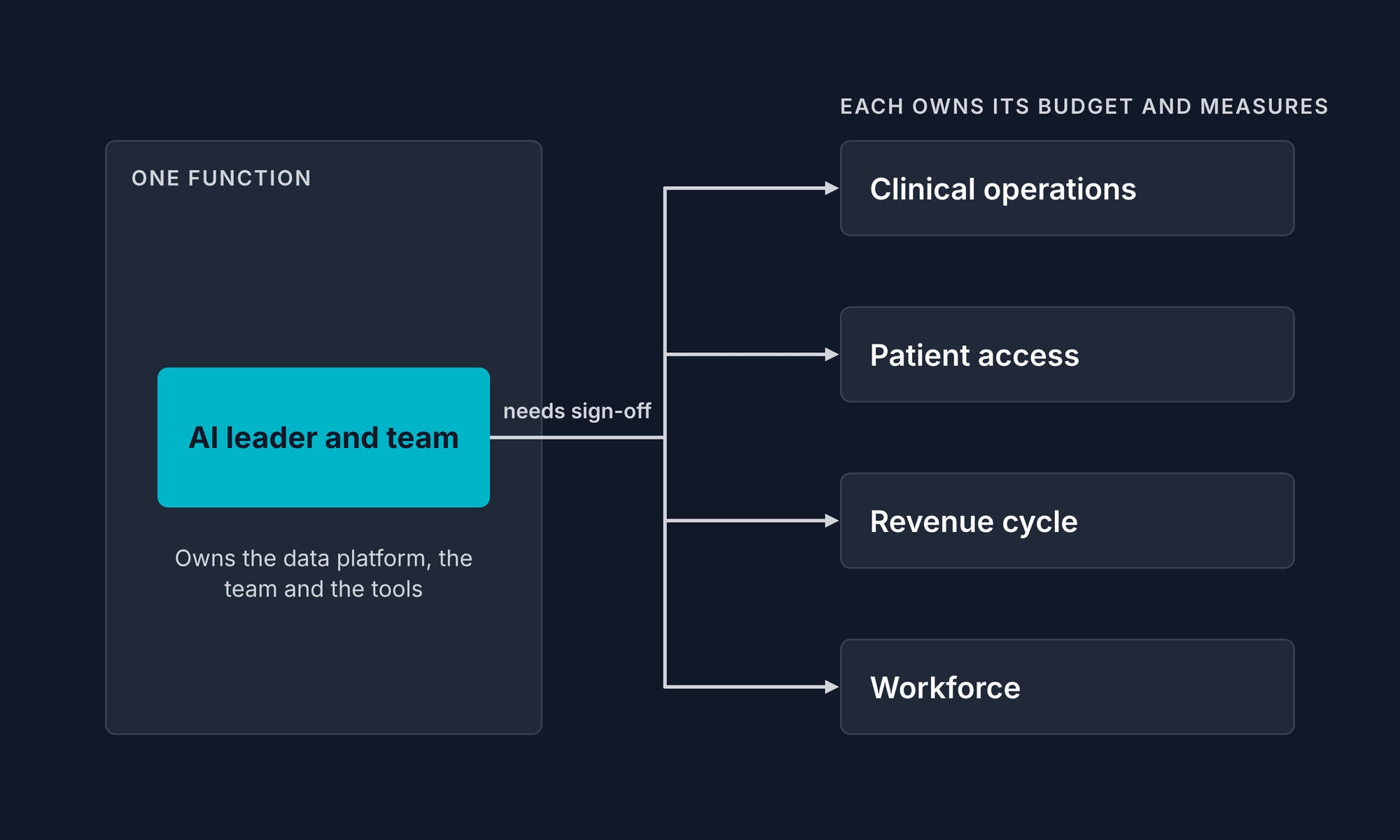
In practice, the AI team can demonstrate a better approach and still need sign-off from several peers before anyone adopts it. The existing process keeps its budget and remains the basis on which managers are evaluated. Training, a roadmap and a governance committee all help. None of them, on its own, assigns the authority to change the work.
Directors are hearing a similar message from their own advisors. The National Association of Corporate Directors calls for clear management accountability for AI, a consistent decision-making model across functions with a path for escalation, and oversight at the level of the whole enterprise rather than department by department. 3
I fully understand why AI may not sit at the top of a health system’s agenda. The leaders I spoke with were focused on immediate operating pressure. That is the strongest argument for putting AI leadership where priorities are set. The job is to show whether these capabilities can advance the priorities the organization already has, not to compete with them for attention.
What an enterprise mandate should include
I would set four expectations when an organization expect AI to change how it operates.
- A named executive, accountable to the CEO
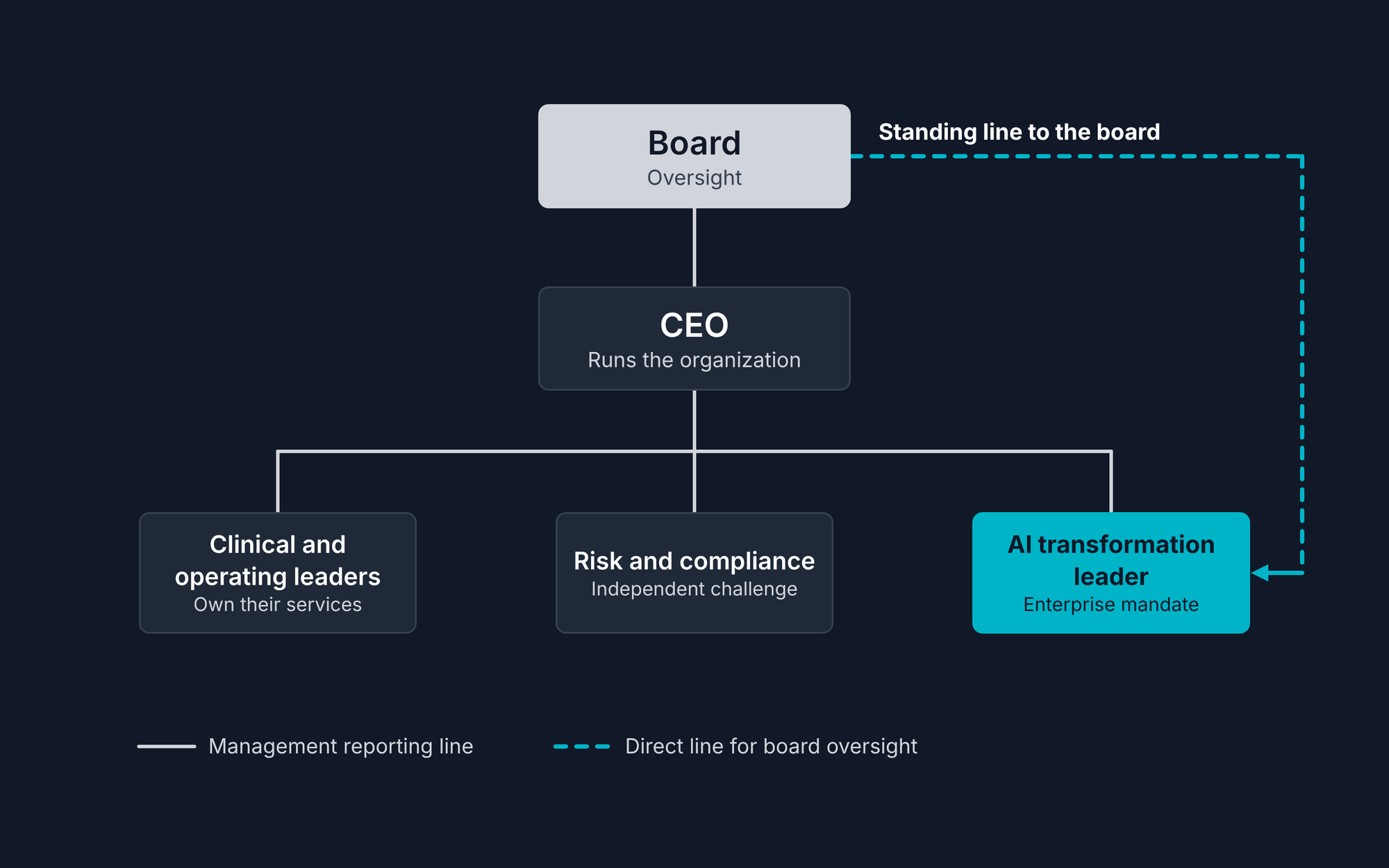
One person answers for the AI transformation program as a whole and takes part in executive prioritization while the organization is still deciding what to pursue, not after the commitments are made. The title matters less than the reach. Whether the role is a Chief AI Officer or an executive whose remit already spans the enterprise, it should not sit beneath any single function. - A standing line to the board
The leader reports directly to the full board or a designated committee on a regular schedule and can raise an issue between meetings. NACD notes that a traditional quarterly cadence can struggle to keep pace with AI and suggests more frequent updates where needed. 3 - Authority that crosses functions
Cross-functional resource and work-design decisions have a defined path to executives empowered to resolve them. Individual initiatives can stay accountable to the clinical and operating leaders who own those services. An enterprise mandate does not mean putting every project under one person. - Outcomes the board can oversee
Board reporting covers the agreed outcomes, what is changing in the work, where the evidence is still weak, the trade-offs that need a decision, and which old tasks are ending. Delivery milestones belong in that picture, but they are not the whole of it.
| Area | A functional remit | An enterprise mandate |
|---|---|---|
| Reporting line | Sits within a function, often several levels from the CEO. | Accountable to the CEO for the transformation program. |
| Board visibility | Summarized in another executive’s update. | Reports directly to the board or a designated committee on a set schedule. |
| Priorities | Receives an approved list of use cases. | Helps set the outcomes before projects are approved. |
| Resources | Allocates the AI team’s budget. | Brings cross-functional resource decisions to executives empowered to resolve them. |
| Work design | Delivers tools and training. | Works with service owners to redesign the work and the capabilities it requires. |
| Accountability | Reports delivery milestones. | Answers for the program’s contribution to agreed outcomes, alongside service owners. |
An illustrative comparison of responsibilities, not a prescribed organization chart.
Healthcare boards have done this before
A direct line from a management leader to the board is familiar territory in healthcare. HHS Office of Inspector General guidance says the compliance officer should report to the CEO or the board, with direct access to the board, and that the board should meet with the compliance officer at least quarterly. 4 The reasons differ though.
The structure, though, is one health system boards already know how to run, and it sits comfortably alongside the CEO’s accountability.
The boundary still matters. The board governs and management manages. A direct line should inform the board’s oversight of the CEO’s agenda, not create a second chain of command. Clinical and operating leaders keep responsibility for their services, and independent risk functions need room to challenge the program.
The seat also carries obligations. The AI leader should be able to explain what a proposed change requires, including where the evidence is thin, and bring unresolved trade-offs to the right decision-maker before they become delivery failures. I would look for someone who understands the technology well enough to question it, has led organizational change, has credibility with clinicians, and will recommend an approach without AI when that is the better choice.
Start with the service
One discussion at the conference stayed with me because it was about a data team’s own work. Producing more reports was no longer meeting the needs brought to it; people needed help using information to get work done.
Take a hypothetical service that helps patients arrange follow-up after discharge. A team might produce a weekly report of outstanding appointments. A more useful service would help staff see what is preventing follow-up and coordinate the next step.
Getting there starts with defining what the service owes the patient, then understanding the current work with the people who do it and the people who receive it. Only then is there a basis for deciding where AI helps. Staff need time to learn the new workflow, not just a new tool. Managers need to agree which responsibilities change. Someone has to establish whether the revised service is working and decide which old tasks can safely end.
A data leader cannot make those decisions alone. They need a working agreement with the service owner and an executive path for choices that exceed either person’s authority. That is what an enterprise mandate looks like at the level of a single service.
Keep the patient in view
I am grateful for conversations that came from people delivering care and studying how to improve it. In talks about patient-facing tools, continued access to a person mattered alongside what the technology could do. Time saved is an opportunity, and leadership still has to decide how it will be used. A service that becomes easier to administer should also be judged from the patient’s side. Holding those objectives together is the core of this role, and it is why the role belongs close to the board.
The structure can evolve as AI becomes part of ordinary management. While the rapid transformation is under way, the mandate should be explicit, the reporting line should reach the board, and the outcomes should be ones the board can oversee and management can act on.
Does your board hear directly from the person leading AI transformation while decisions are being made, or a summary of delivery after they have been?
Sources and further context
- Mayo Clinic: Board of Trustees elects Matthew R. Callstrom, M.D., Ph.D., as next president and CEO November 13, 2026. Appointment, prior roles, board memberships, and leadership continuity.
- Mayo Clinic: Upcoming leadership transition May 12, 2026. Planned January 1, 2027 transition.
- National Association of Corporate Directors: Implementing AI Governance Director Essentials, September 2025. Management accountability for AI, cross-functional decision-making and escalation, enterprise-level oversight, business-unit accountability, and reporting cadence.
- HHS Office of Inspector General: General Compliance Program Guidance November 2023. Compliance officer reporting line, board access, and meeting cadence.