
The Real Innovation Behind First-Dollar Coverage Wasn't the Pricing — It Was the Behavior
How Surest rewired member decision-making without rewriting provider contracts — and what the next wave of plan innovators is actually competing for.
How Surest rewired member decision-making without rewriting provider contracts — and what the next wave of plan innovators is actually competing for.
First-dollar coverage is no longer a novelty. Plans with no deductible, clearer prices, and cleaner digital experiences are no longer fringe concepts in the commercial employer market. Even though 88% of covered workers face a general deductable. But a plan that looks modern is not necessarily a plan that changes member behavior in durable ways.
That distinction matters more than it may seem. Employers are trying to manage real cost pressure. Investors are trying to understand what is truly defensible. Payer leaders are deciding what to build, what to partner for, and what kind of product architecture can actually scale.
I spent years helping build what became Surest, and one reason I continue to pay attention to this market is that many conversations still focus on the visible surface of these products rather than the mechanism underneath. The visible surface matters. But it is not the real innovation.
The deeper innovation was behavioral.
The Innovation Was Behavioral Architecture, Not Price Transparency
When people describe Surest, they often land on price transparency as the differentiator. That is directionally right, but it does not fully explain what made the model work.
From my vantage point, the more important innovation was behavioral architecture: a product design that aligned member incentives and employer cost interests at the moment a care decision was made.
At a high level, the breakthrough was not rewriting provider reimbursement. It was turning messy claims, network, and outcomes data into a member-facing price signal that people could trust when they were actually choosing where to go for care.
That sounds simpler than it is. Claims data was built to support provider payment, not consumer shopping. Network data is rarely clean from a member perspective. Providers may bill under multiple entities, across multiple locations, with naming conventions that make sense administratively but not for consumers. To make a member-facing price feel credible, the experience has to be more than informative. It has to be dependable. The displayed price has to align closely enough with the adjudicated result that members believe it and use it.
That trust layer was foundational. Without it, the product becomes a browser. With it, it becomes a behavioral tool.
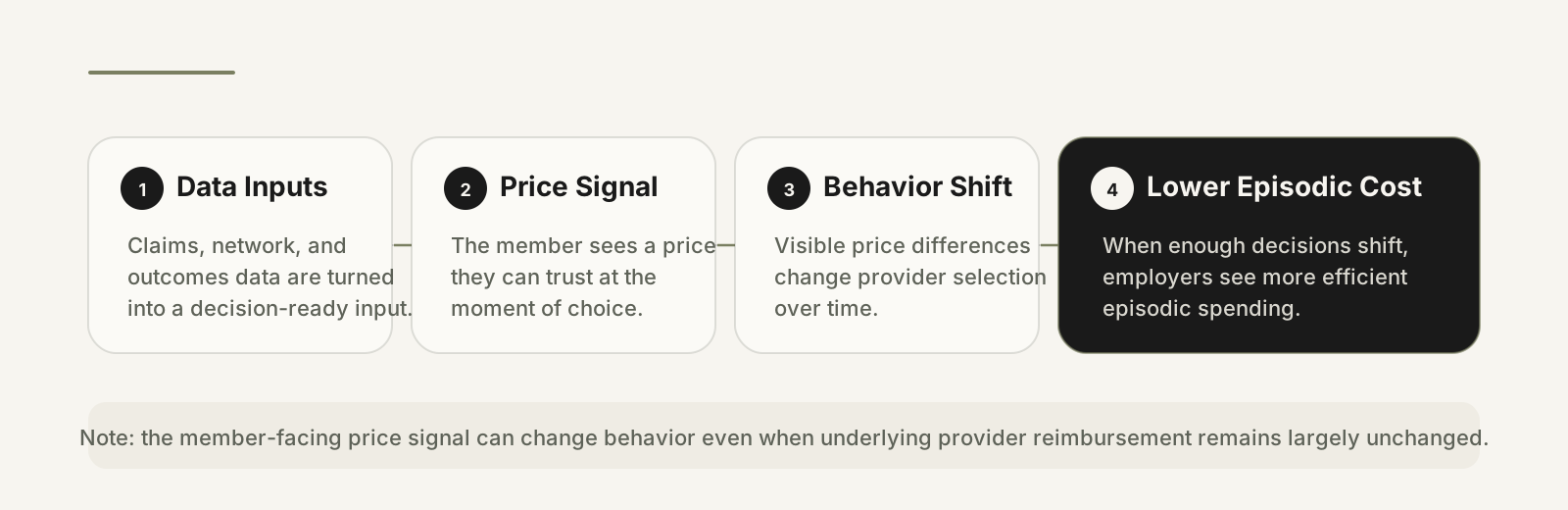
And that is the point that often gets missed. The model did not depend on removing choice or forcing members into a narrow path. The broader provider network remained accessible. What changed was the financial and informational architecture around the decision. Members could still choose widely, but they had a visible reason to choose differently.
When enough people do that, consistently enough, employers begin to see meaningful cost movement. Members also experience the product differently because the plan becomes easier to navigate at the point where confusion usually shows up: the actual care decision.
None of that was the work of one function. It required product, actuarial, operations, engineering, network, and data teams working in lockstep.
Three Bets on the Same Problem
Surest is not the only model aimed at changing member behavior. What is emerging in the market is not one design pattern, but several distinct bets on the same underlying problem: how to create durable behavior change in a product category where most consumers have historically had very little incentive, information, or confidence to behave differently.
| Model | Behavior moment | Primary lever | What compounds | Main trade-off |
|---|---|---|---|---|
| Continuous price-signal model | Repeated point-of-care decisions | Visible member price differential | Behavioral data depth | Requires trusted pricing and strong data plumbing |
| Entry-gate model | Front-end plan activation | Required baseline/compliance step | Care-management access | More front-loaded than continuous |
| Benefit-amount model | Point-of-service payment decision | Upfront benefit amount + direct-pay economics | Structural cost position | Depends on provider pricing behavior and post-visit reconciliation |
The continuous price-signal model: One model uses price visibility and choice architecture at the point of service to influence behavior repeatedly over time. This is the core pattern Surest helped pioneer. The idea is not just to show prices. It is to make those prices actionable, credible, and behaviorally meaningful across a broad set of care decisions.
The strength of this model is that it creates repeated decision moments. The member is not guided once. They are guided again and again, across the care journey. Over time, that also creates a valuable behavioral data asset: which choices people make when given transparent financial signals, and how those choices correlate with downstream cost.
The entry-gate model: A second model creates behavior change through a structured entry requirement. Curative is the clearest example. The member is required to complete an initial visit with a designated provider in order to retain the most generous in-network benefit design. Fail to do that, and a large deductible activates. The result is 98% app engagement and compliance with the initial care pathway, a number no other commercial plan has come close to.
The strength of that model is obvious: it creates a very strong managed entry point into the system. That can be powerful for primary care engagement, early risk identification, and downstream care management. The trade-off is that the behavioral intervention is concentrated at the front of the journey rather than repeated at each point of service. Everything in-network costs zero and out-of-network care is handled via a credit card at cash price — an elegant back-office simplification that bypasses network negotiation overhead entirely for that slice of utilization, but does has some potential experience abrasions.
The benefit-amount model: A third model shifts the economics by simplifying the transaction itself. Sidecar Health is an example of this broader approach. Rather than relying primarily on steerage through networked negotiated rates, the product leans more heavily on upfront pricing, direct payment mechanics, and a different reimbursement structure.
The attraction is structural simplification. Administrative friction in healthcare is real, expensive, and often underappreciated and consumes an estimated 20–30% of total spend in the conventional model. Any model that reduces the friction around payment, billing, and member confusion has a meaningful value proposition.
The trade-off is also structural. These models depend on how durable the gap remains between direct-pay economics and conventional commercial reimbursement, and on how broadly that logic can scale across markets, providers, and service types.
These three models are not competing primarily on member experience aesthetics or app design. They are competing on which behavioral architecture produces the most durable cost outcomes at scale — and they each generate a fundamentally different underlying asset in the process.
What the Next Competitive Frontier Is Actually About
The most interesting part of this market is no longer the deductible story alone. It is what each architecture creates over time.
A continuous price-signal model creates a behavioral data asset. Over time, the product learns which signals change decisions, which providers members actually choose when shown meaningful price variation, and how those choices connect to downstream episodic cost. That asset compounds with usage and time.
An entry-gate model creates a care-management asset. It establishes early contact with a large share of the population and creates a stronger opening for navigation, clinical engagement, and risk identification.
A benefit-amount model creates a cost-position asset. It is structurally oriented around administrative simplification and a different economic relationship between member, provider, and payer.
That is why I do not think the next phase of competition is really about who has the cleanest interface. It is about which architecture creates the most defensible long-term advantage.
For incumbents, that raises a harder question than it first appears. Large plans have capital, brand, networks, and distribution. What they often struggle with is not whether they can copy a visible feature. It is whether they can protect the decisional velocity required to build a product that behaves differently from the legacy core.
That kind of product usually cannot be built as a light overlay on top of an existing claims engine, a legacy member portal, and a standard operating rhythm. It usually requires a more protected build environment early on — something closer to an internal startup than a traditional line extension. Integration matters, but in my experience it tends to matter most after the product logic is proven, not before.
For plan sponsors, the strategic question is not simply which product looks most modern or which PMPM headline sounds best. It is which behavioral architecture fits the population they are covering, and which model is most likely to improve decision quality over a multi-year horizon.
For investors and payer strategy teams, the question is slightly different: which underlying asset compounds most defensibly as more competitors enter the market?
A first-dollar coverage option is now table stakes. The race now is for the behavioral and operational advantage built underneath it.