The Trust Layer: Where Enterprise Healthcare AI Gets Decided
Model quality is commoditizing. The decisive factor is now whether a system can be trusted at healthcare scale. To understand where the market is heading, look closely at the vendors quietly winning enterprise traction right now.
A useful way to understand where healthcare AI is heading is to look closely at the vendors that are quietly winning enterprise traction right now. They are not always the ones with the most impressive technical demos. In many cases, they are the ones whose products are slightly less novel — occasionally meaningfully so — than competitors that have raised more capital and earned more press attention.
What distinguishes them is something different. They have built trust as a feature of the platform rather than a property of each individual deployment.
The view from 1,000+ enterprise AI evaluations
I spent four years on the AI review board at UnitedHealth Group, where I saw more than a thousand solutions come through evaluation — vendor pitches, internal builds, partner integrations across every line of business. The solutions that moved from review to production were consistently the ones that arrived already integrated into the enterprise's trust architecture: governance layer, logging capability, data usage controls, escalation paths, audit posture.
That pattern points to something the market is still catching up to. A capable model is necessary, but it is the surrounding system — the governance, observability, and accountability layer — that determines whether a healthcare organization can actually deploy something probabilistic into a regulated environment without absorbing risk it cannot describe to its board, its regulators, or its customers.
This is the trust layer. It is becoming one of the most strategically valuable parts of healthcare AI, and the organizations that continue to build it well — on both the buying side and the building side — are the ones set up to persist as the market matures.
What Trust Actually Means Inside a Healthcare Enterprise
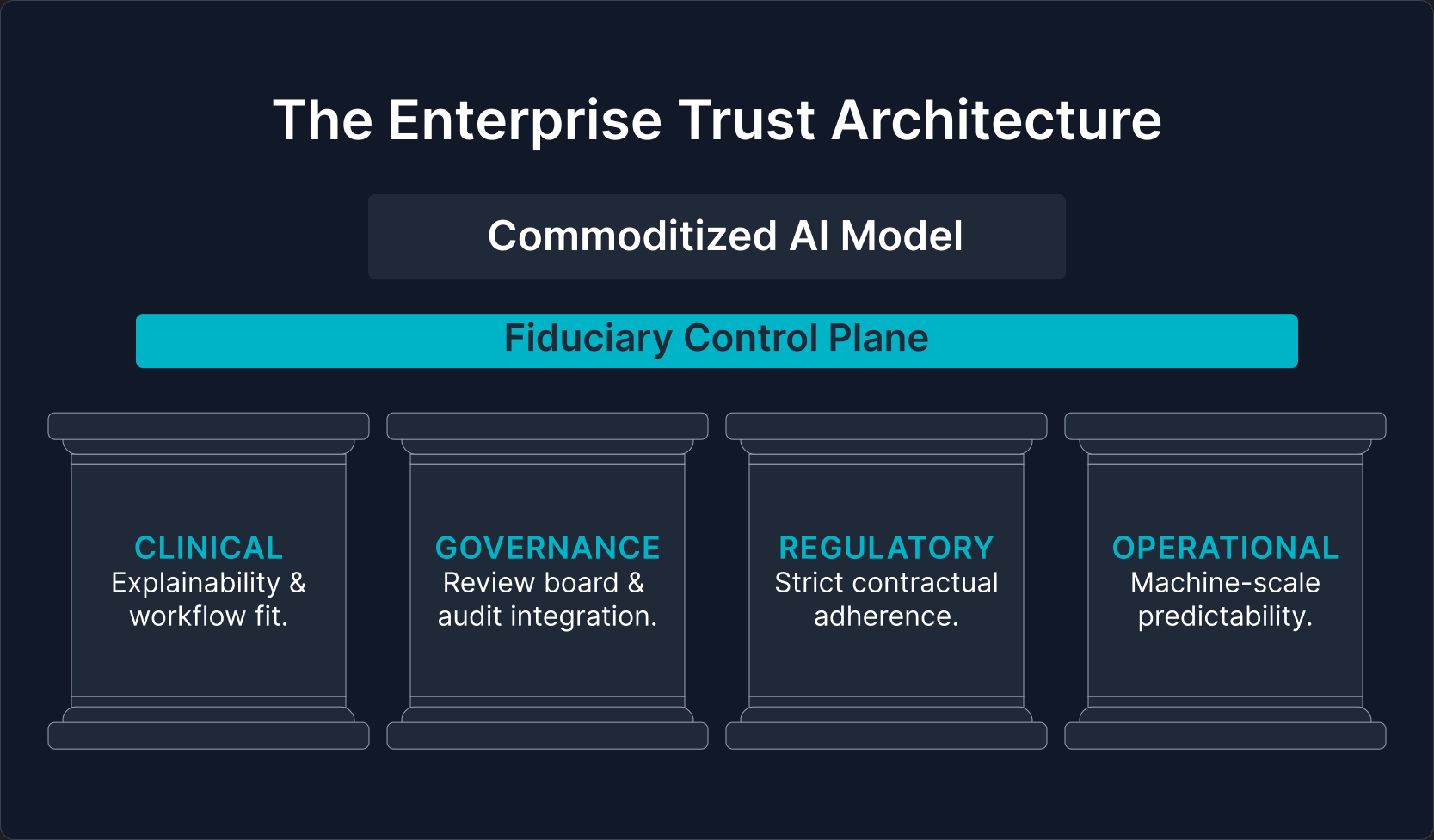
The conversation about AI trust has, appropriately, started with clinical-facing concerns. That focus is well placed; clinical trust is foundational. What I want to add is depth: inside a large healthcare organization, trust is not a single requirement but several activities can be bucketed into four distinct layers, each with its own owner and its own measure of success.
Clinical trust: Where the conversation rightfully begins. Can the model produce outputs that physicians and nurses are willing to act on, with explainability sufficient for the clinical conversation and workflow integration that supports rather than disrupts the way care is delivered? It is the most visible layer because it sits closest to the patient.
Governance trust: The layer most often underestimated, particularly by vendors. Does the system integrate with the buyer's AI review board process, data usage controls, model approval workflow, and audit requirements? At the large-payer scale where I helped lead this work, every AI solution — internal or vendor — had to clear an AI review board with a data governance contact embedded in the process. Solutions that arrived with their own governance plane that could plug into the enterprise's plane moved faster. Solutions that required the enterprise to build the governance wrapper around them can often stall or fall out of the pipeline.
Operational trust: Does the system behaves predictably enough at machine velocity to fit into the way work actually gets done? This is partly the decision telemetry question — tool invocations logged, model versions tracked, sanitization layers verified, human-in-the-loop thresholds defined where they are warranted. But it is also a workforce and workflow question: does the system fit the operational process the people around it already run, and does it support the workforce rather than ask them to absorb new friction? Operational leaders deploy with confidence when both the telemetry and the workflow fit are in place.
Regulatory trust: Can the system can operate within the contractual and legal commitments the enterprise has already made to plan sponsors, providers, members, and regulators. The clearest current example: a major payer's policy that a probabilistic algorithm cannot make a negative determination on a prior authorization. That is not a technology constraint. It is a contractual and regulatory commitment that flows from the organization's obligations, and any AI deployment has to operate within it. Solutions built on the assumption that the enterprise will adjust its risk posture to accommodate the technology are not set up for success.
The organizations and vendors I see succeeding now are those that treat all four layers as a single, integrated trust problem rather than four separate concerns to be solved in series.
Why the Vendors Winning Right Now Look the Way They Do
Two vendor patterns illustrate this clearly.
First: deterministic vendors that have been operating in healthcare for years, often unnoticed by the broader AI conversation, who are now adding language model interfaces to capabilities they had already built and earned trust around. Patient scheduling systems. Benefits verification voice bots. Claims pre-adjudication tooling. These are not the companies on the front page of trade publications, but they have something most AI-native entrants do not: trust earned with healthcare buyers through years of deterministic operation. Adding a probabilistic interface to a system that has already cleared governance has been a much easier path than introducing a probabilistic system that still needs the governance built around it.
The second pattern is among the AI-native healthcare voice and agent platforms. The ones gaining real enterprise traction are those that built their governance posture as a core platform feature — explicit governance layer, clear integration points for the buyer's AI review process, logging and observability as defaults rather than enterprise add-ons. The ones finding it harder are those whose perception of trust is that it is something each individual deployment has to determine on its own.
I have evaluated both kinds, and the distinction is not subtle. A vendor that arrives saying "here is my governance layer, here is how it integrates with yours, here is how my system plugs into your AI review process" is in a fundamentally different procurement conversation than a vendor whose product is technically excellent but whose answer to "how does this work with our governance" is to point toward the documentation.
The point is not that one type is better than the other. It's that enterprise procurement in regulated healthcare environments favors whichever vendor reduces the buyer's trust burden the most.
The Implication for Healthcare Operators
For payer and provider executives thinking about how to position their organizations for the next wave of AI adoption, the implication is direct: trust is not a function your AI program operates within. It is a capability your AI program needs to build, own, and treat as core operating infrastructure.
This is not the same thing as having an AI policy. Policies produce documents. Trust as operating infrastructure produces controls — engineered systems for identity, observability, and accountability that live inside the way the organization actually runs.
Organizations must be clear-eyed about this tradeoff. Moving quickly on AI adoption — turning capabilities on, building momentum, getting tools into people's hands — has real competitive value, and some organizations are accepting elevated risk to capture that speed. That can be a reasonable choice. But it is only reasonable when the risk is understood and bounded. The danger is not moving fast; it is moving fast while accumulating risk the organization cannot see, cannot describe, and cannot roll back if a governance review later requires it.
Speed taken on top of a trust layer is a competitive advantage. Speed taken in the absence of one is a liability that compounds quietly until it surfaces at the worst possible time.
The organizations that build the trust layer early gain three durable advantages. They adopt AI faster on each successive use case, because new deployments plug into existing governance rather than rebuilding it each time. They procure better, because their evaluation criteria are sharper than competitors still asking surface-level capability questions. And they operate with less regulatory and contractual exposure, because every probabilistic decision in the system is reconstructible and auditable.
What This Looks Like in Practice
For an executive deciding where to invest now, the posture is straightforward.
On the build side: Treat the trust layer as a first-class capital investment rather than a compliance checklist. Real enterprise trust requires engineering across three dimensions simultaneously:
- Technical Governance: Go beyond writing policy documents. Architect identity and access for non-human entities, mandate strict logging of tool invocations, and enforce input/output sanitization that is stricter than equivalent human channels. Human-in-the-loop thresholds must be rigorously calibrated to specific risk categories, and sensitive identifiers must be injected through deterministic tools rather than carried in probabilistic context.
- Clinical Workflow Integration: Design for explainability that a clinician can actually use at the point of care. The technology must fit seamlessly into the operational process the workforce already runs rather than forcing them to absorb new steps.
- Change Management & Regulatory Alignment: Invest heavily in the operational training that allows the humans in the loop to trust the system enough to rely on it. Finally, confirm that all contractual and regulatory commitments hold firm before a single agent reaches production.
A system that is fully governed but poorly fit to the workflow will become a sunk cost as clinical teams invent workarounds. A system that is well-fit but poorly governed will simply fail to clear the review board.
On the buy side: Raise the bar in vendor evaluation. The first questions in the next procurement cycle should not be about model capability — most serious vendors are now competent enough at the model layer that capability is rarely the binding constraint. The questions should be about how the vendor's governance integrates with yours, whether their logging is sufficient for your audit posture, and what happens specifically when your governance posture tightens and theirs has not. In addition to making sure all the workflow and workforce focus questions in build are asked as well.
On the leadership side: Recognize that trust is not delegable to legal or compliance alone. It is an enterprise capability that needs an owner at the executive level — increasingly the Chief AI Officer or equivalent — and an operating model that lets the rest of the organization deploy AI without reinventing the governance posture each time.
The organizations that get this right are the ones whose trust architecture lets the rest of the business move forward — faster and more safely — without renegotiating the same risk questions on every deployment. That is what enterprise readiness looks like at this stage of the market.
The Strategic Frame Worth Carrying Forward
Healthcare AI has reached the point where the model layer is commoditizing faster than the trust layers can keep up. That gap is the single most important commercial signal in this market right now. It is why deterministic vendors with years of earned trust are adding language model interfaces and gaining ground on AI-native competitors with stronger underlying technology. It is why governance-integrated platforms are clearing enterprise procurement faster than capability-leading platforms that arrive without one. And it is why organizations treating governance as infrastructure are moving faster on each successive deployment, not slower.
Expect the tooling to start meeting this need directly. We are already seeing early movement toward "glass box" models and transparency layers — systems designed so that their reasoning, data access, and decision paths are observable and auditable by design rather than reconstructed after the fact. As that tooling matures, building the trust layer will get easier, and the bar for what counts as enterprise-ready will rise accordingly.
The underlying point is simple. Soon enough, the quality of the model will be a commodity. What will matter is whether you can trust it — trust that it operates within your governance, your regulatory commitments, your workflows, and your risk tolerance. That is the part worth investing in, on both sides of the procurement conversation.